


Increasing Knowledge of science is changing dramatically. As many innovations in science and technology emerge, they have the potential to eliminate unskilled labor on a global scale. There is also a growing need for skilled workers with mathematical, computer, and information skills. This issue covers a variety of disciplines, including science, social sciences, and humanities. To move towards this dynamic, education needs to shift its focus from memorizing content. Instead, emphasis should be placed on critical thinking, problem-solving skills, creativity, and diversity of thought. Students must develop the ability to innovate, adapt, and continually acquire new knowledge in emerging fields.
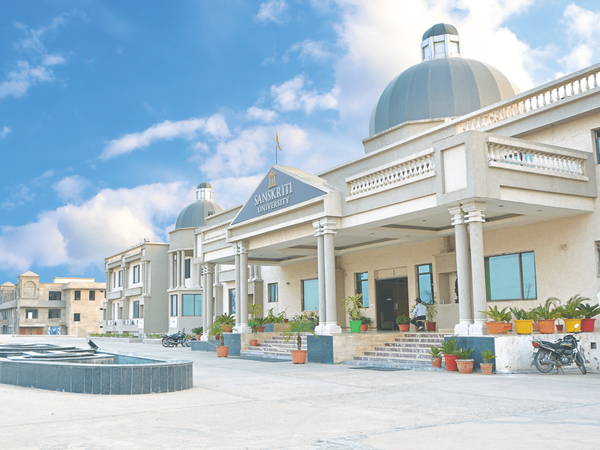
Education needs to be transformed into an experiential, holistic, comprehensive, research-based, and student-centered structure. Industry collaboration is essential to bridge the gap between academia and global needs. A recently launched engineering program at Sanskritis University reflects this approach. These flexible schedules allow working professionals to grow while continuing their studies. By combining ideas with practical industry experience, the university aims to prepare graduates for business life and enable them to make a positive contribution to the changing world.

Duration: 3 Years (6 semesters)
Approval: UGC, PCI, BCI etc.
Duration: 3 Years (6 semesters)
Approval: UGC, PCI, BCI etc.
Duration: 3 Years (6 semesters)
Approval: UGC, PCI, BCI etc.
Duration: 3 Years (6 semesters)
Approval: UGC, PCI, BCI etc.
Duration: 3 Years (6 semesters)
Approval: UGC, PCI, BCI etc.

Duration: 2 Years (4 semesters)
Approval: UGC, PCI, BCI etc.
Duration: 2 Years (4 semesters)
Approval: UGC, PCI, BCI etc.

Duration: 2 Years (4 semesters)
Approval: UGC, PCI, BCI etc.
Duration: 2 Years (4 semesters)
Approval: UGC, PCI, BCI etc.
Duration: 2 Years (4 semesters)
Approval: UGC, PCI, BCI etc.
In a flexible time-shift, the engineering program provides practical learning experiences, connects academics and industry, and allows students to succeed in the engineering industry.
A flexible time shift program that allows professionals to pursue advanced engineering degrees while supporting their current practice. These programs are designed to provide a balance between solid knowledge and practical experience.
The University emphasizes the integration of theoretical concepts with real-world realities. Students participate in practical activities, case studies, and industry collaborations. This approach assumes that graduates are not only technically skilled but also have practical knowledge of other chosen fields.
Participants in flexible architecture programs gain self-confidence, become better problem solvers, and better understand engineering principles. Exposure to the elements increases the workload and prepares them for modern terrain.
The University provides a platform for students to connect with professionals in their field of interest. These networking opportunities develop valuable relationships that can make a big difference in your future.

Flexible time courses focus on modern skills, emphasizing basic skills and practical applications. Students gain a better understanding of their fields as they prepare for the graduate workforce.
The technical courses comply with the All India Council for Technical Education (AICTE*) standards as mentioned in the relevant manual.
Courses are conducted on weekdays (in the evenings after professional working hours), weekends, and public holidays to meet credit requirements as per AICTE* guidelines.
Laboratory studies are held on campus every Saturday.
Once the course is completed, records of lessons will be accessible via the Learning Management System (LMS) due to viewing limitations.
Students can access the laboratory remotely and simulate real-time experiences via video. These labs are available 24/7, allowing students to test their skills at any time.
Performance is monitored and evaluated through a variety of learning activities, including course tests, exams, assignments, practice tests, and semesters.
Students’ progress and preparedness in the course will be tested by various type of examinations like Mid Term , End Term ,Practical Exam & VIVA Voce via proctored and offline mode.

On Saturdays, participants attend laboratory sessions on campus. These labs provide hands-on experience and strengthen ideas. Virtual and remote laboratories can be accessed 24/7 using virtual reality simulation. Students can conduct experiments, solve problems, and evaluate their skills remotely. Flexibility allows them to learn at their own pace.

Professionals working on projects and research related to their field. These real-world teachings bridge the gap between theory and practice. Working with industry partners, students solve real-world problems and use their knowledge to solve practical problems.

Students connect with professionals and experts in their field. Coordinating events, workshops, and guest lectures to build better relationships. During flexible shift classes, the peer group creates a supportive community that encourages knowledge sharing and collaboration.

Regular assessment, questions, and assignments for continuous learning improvement. Instructors provide timely feedback and guide students through the course as they progress through the semester.

Flexibility allows professionals to manage their working hours more efficiently. Students can combine work, family, and education. Motivation and discipline are essential for success in this learning style.

Learning programs for professionals working on a timescale relevant to their current practice. Lessons are held on weekdays (usually evenings), weekends, and public holidays. Participants can collaborate with teachers, ask questions, and collaborate with colleagues. After the live lessons, the recorded lessons can be accessed via the Learning Management System (LMS). Students can repeat these recordings to strengthen their understanding of the materials.










Sanskriti University offers B.Tech Lateral Entry programs in five specializations: Computer Science Engineering, Civil Engineering, Electrical Engineering, Electronics & Communication Engineering, and Mechanical Engineering. These programs are designed for diploma holders and allow direct admission into the second year of B.Tech.
Yes, Sanskriti University's engineering programs are approved by the University Grants Commission (UGC) and follow AICTE standards. The university is also recognized by AIU and the Bar Council of India, ensuring nationwide recognition of its degrees.
The flexible time-shift program is specially designed for working professionals. Classes are conducted during evening hours on weekdays, weekends, and public holidays. Students also get access to recorded lectures, virtual labs, remote labs, and LMS support 24/7 for flexible learning.
Sanskriti University has a strong placement record with 85% placement support, participation from 200+ recruiters, an average package of ₹6.20 LPA, and the highest package reaching ₹54 LPA. The university regularly conducts campus placement drives and industry interaction sessions.
Candidates who have completed a 3-year polytechnic diploma in a relevant engineering field are eligible for B.Tech Lateral Entry admission. B.Sc. degree holders with Mathematics at the 12th level and B.Voc. graduates in relevant streams may also apply. Working professionals with relevant experience are encouraged to enroll in the flexible time-shift program.